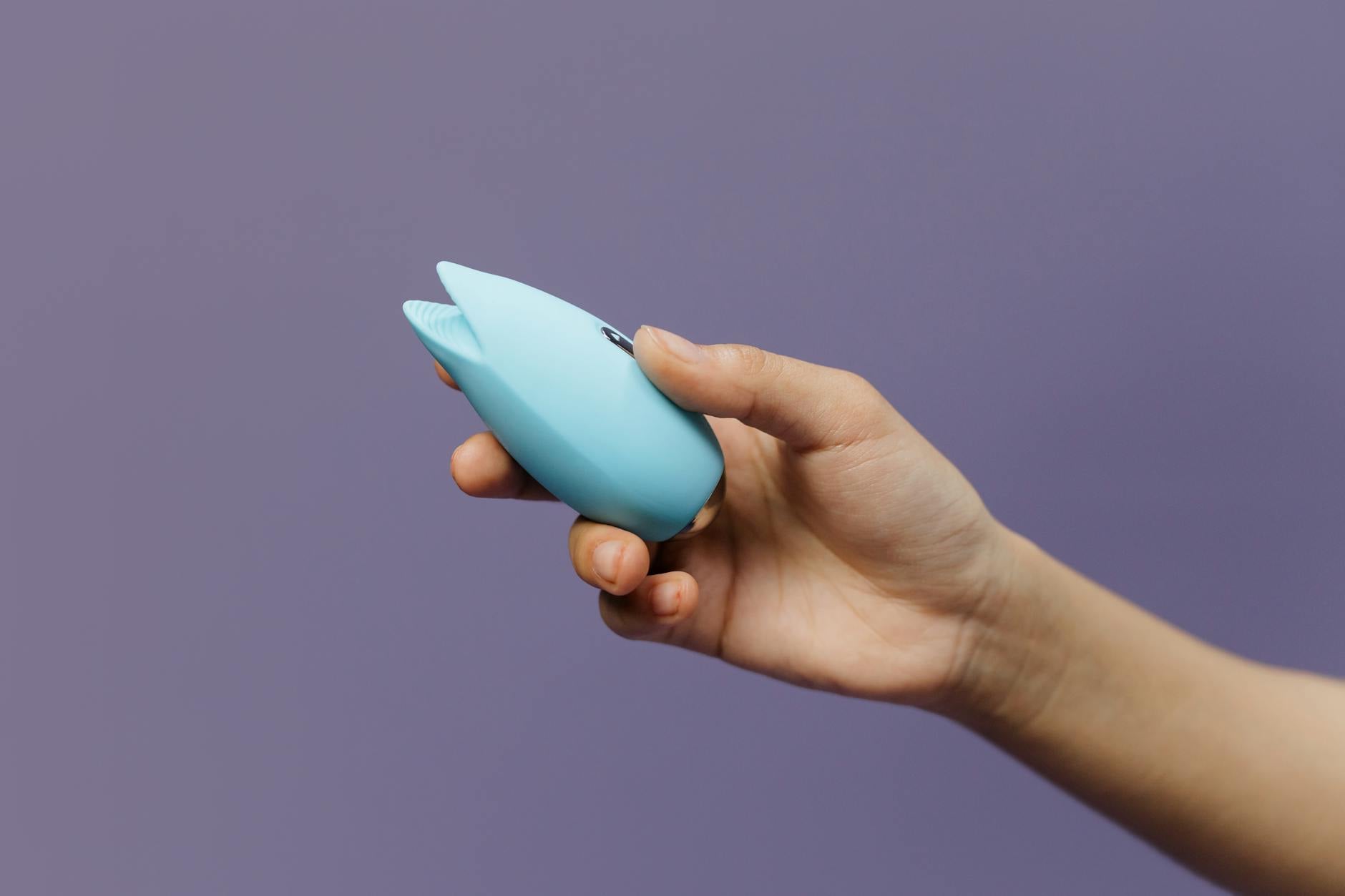
Let's name what actually happens
You want to have solo sex. Your body wants to have solo sex. And then your brain decides it's the perfect moment to remind you that you have seventeen unfinished tasks, that email you sent was awkward, and what if someone walks in. Just like that, arousal flatlines.
This isn't a moral failing. It's your nervous system doing exactly what it was designed to do. Anxiety triggers the sympathetic nervous system, which floods your body with cortisol and adrenaline. That's fight-or-flight mode. Your blood vessels constrict. Your pelvic floor tightens. Lubrication slows. Sensation numbs. You're literally physiologically primed to run from a predator, not to feel pleasure.
Most advice about anxiety during sex stops at "just relax" or "practice mindfulness." That's true and entirely unhelpful when you're already triggered.
Why lemon clitoral vibrators change the equation
A lemon vibrator works differently than your fingers or a partner's touch. Here's why that matters for anxiety.
First, it creates consistent, non-negotiable sensation. Anxiety makes you hypervigilant about your own body. Am I doing this right? Does this feel good? Should I be feeling something by now? The constant internal commentary becomes the main event, pushing pleasure to the background. A lemon clitoral vibrator removes the "performance" element because the sensation is constant and external. You're not generating it. You're receiving it. That small shift in agency often quiets the anxiety loop.
Second, the suction mechanism of a lemon vibrator stimulates a much larger area of nerve tissue than direct pressure does. When you're anxious, your nervous system is hypersensitive to threat. Gentle, diffuse pressure feels safer than intense, localized friction. Lemon vibrators were engineered specifically around this principle: broad stimulation without the sharp intensity that can feel overwhelming.
Third, the rhythm is predictable. Anxiety hates uncertainty. A lemon vibrator pulses at the same pattern repeatedly. Your nervous system gradually learns "this is safe, this is consistent, this will keep happening." That predictability, over 5-10 minutes, starts to downregulate your fight-or-flight response.
The vagus nerve connection
Deep in your nervous system lives the vagus nerve. It's the main line of communication between your brain and your body, and it controls whether you stay in sympathetic (anxious) mode or shift to parasympathetic (relaxed) mode.
When you're anxious, your vagus nerve is in flight mode. It's restricting blood flow to your genitals and dilating your pupils instead. Pleasure requires parasympathetic activation. This is why the best foreplay for an anxious person is often the stuff that feels completely unsexy: slow breathing, gentle pressure, predictable rhythm.
A lemon vibrator's pattern of pulse and release naturally invites parasympathetic activation. The rhythm slows your nervous system. The suction sensation is directional but not aggressive. The experience is sensory enough to pull your attention out of your spinning thoughts but not so intense that it triggers more anxiety.
How to use a lemon vibrator when anxiety is running the show
Timing matters. Don't wait until you're already in panic mode. Use the lemon vibrator as a tool to establish calm first, then let pleasure follow.
Step 1: Breathe before you touch. Spend two minutes doing 4-count inhales and 6-count exhales. This activates the parasympathetic nervous system on its own. You're not trying to "feel sexy." You're just downregulating your nervous system.
Step 2: Start at pattern 1 or 2. Low intensity. The goal here is consistency, not intensity. You're training your nervous system to recognize safety.
Step 3: Notice where anxiety lives in your body. Is your jaw clenched? Is your pelvic floor tight? Is your chest restricted? Spend 30-60 seconds using the lemon vibrator anywhere except your clitoris. Inner thigh. Lower abdomen. The goal is sensation without the pressure of "this should lead somewhere."
Step 4: Move to your clitoris only when you notice your body has softened. You'll feel the shift. Your breathing will deepen. Your muscles will release. This is your nervous system saying it's safe now.
Step 5: Stay with one pattern. Don't chase sensation by jumping between settings. Consistency is the point. Let your body build arousal on its own timeline.
This whole process usually takes 10-15 minutes. That feels slow if you're used to a faster arousal trajectory. That's exactly the point. Anxiety thrives on rushing. Pleasure, when you're anxious, needs permission to move slowly.
The permission piece (this matters more than the toy)
Honestly though. The lemon vibrator is half the equation. The other half is giving yourself explicit permission to have a sexual experience that doesn't look like what you thought it would.
If you expected 20 minutes of arousal and orgasm in 30 minutes, and instead you're looking at 30-40 minutes of very slow, very gentle sensation work, anxiety will use that against you. "See, you're broken. Other people don't need this much time." That voice is lying. Other people either aren't anxious or aren't paying attention to their own process.
When you use a lemon vibrator with anxiety, you're not using it to force an outcome. You're using it to create an environment where your nervous system can finally relax enough to feel anything at all.
When to reach out for more support
If you're using a lemon clitoral vibrator consistently, starting with the breathing work, staying at lower intensities, and you're still not feeling any shift in your anxiety after a few weeks, talk to a therapist who specializes in sexual anxiety. Sometimes the anxiety isn't about sensation. Sometimes it's about deeper stuff: relationship history, body image, childhood messages about sex. A sex-positive therapist or somatic therapist can help untangle that. A vibrator is a tool, not a cure for complex trauma.
Also worth mentioning. If your anxiety is new and sudden, check in with a doctor. Sudden onset sexual anxiety can sometimes be a sign of medication side effects, hormonal shifts, or other medical stuff that deserves attention.
Why this actually works
Lemon vibrators help with anxiety during solo sex because they externalize the stimulation, create predictable rhythm, and activate the parasympathetic nervous system. But the real magic is simpler than that. When you're holding a lemon vibrator, you're not thinking about whether you're doing this right. You're not wondering if your body is broken. You're just feeling sensation.
That's not mindfulness or spiritual bypassing. That's your anxious brain finally getting a break from narrating everything. And in that break, pleasure lives. Learn more about using lemon vibrators with different sensation preferences during foreplay if you're exploring how to extend arousal time with a partner.
FAQ: Lemon Vibrators and Anxiety
Will a lemon vibrator work if I'm on antidepressants that affect sexual response?
Lemon vibrators can help, but they're not a workaround for medication-induced sexual side effects. If you're on SSRIs or other medications that suppress arousal, you might need both strategies. The vibrator helps you access sensation. A conversation with your doctor about timing (taking medication after sex, not before), dosage, or switching medications addresses the root issue. Many people find lemon vibrators helpful specifically when managing medication-related challenges. It's not either-or. It's both.
How long until a lemon vibrator actually helps with anxiety?
Most people notice a shift in their third or fourth session using the breathing-plus-slow-pattern method described above. Your nervous system needs repetition to learn that something is safe. Three times isn't quite enough. But by session four or five, many people report that even thinking about using the vibrator starts activating a calm response. That's your vagus nerve learning.
Can I use a lemon vibrator if I'm also in therapy for sexual anxiety?
Absolutely. In fact, tell your therapist you're using it. A good sex-positive therapist will incorporate the vibrator into your work, not compete with it. They might ask you to notice what happens in your body during use, what sensations feel safe versus overwhelming, whether the anxiety narrative quiets down. The vibrator becomes data for your therapy.
What if a lemon vibrator makes my anxiety worse?
Stop and don't use it for a few days. Some people with severe anxiety find that adding stimulation feels like too much input when their nervous system is already overloaded. If that's you, try the breathing work without the vibrator first. Once your nervous system can handle that, reintroduce the vibrator at the absolute lowest setting. If it still feels worse, that's information. You might need therapy before adding tools. That's not failure. That's wisdom.
Is using a lemon vibrator to manage anxiety during solo sex the same as using it with a partner?
No. When you're alone, the nervous system challenge is internal. Your brain is the threat. You're managing the conversation between your body and your mind. With a partner, the anxiety often includes external elements: performance pressure, worrying about their judgment, timing mismatch. A lemon vibrator helps in both situations, but the psychological work looks different. Solo use is often simpler to start with because there are fewer variables.
Do I have to use patterns, or can I just hold it on one setting the whole time?
One setting is absolutely fine. Patterns can feel like too much input when anxiety is high. If one steady pulse feels right, stick with that. Your nervous system doesn't care about variety. It cares about predictability. Many people who struggle with anxiety actually prefer the simplest, most consistent option.
The bottom line
Anxiety during solo sex isn't something you have to white-knuckle through. Your nervous system isn't broken. It's doing exactly what it evolved to do. A lemon clitoral vibrator, combined with intentional breathing and permission to move slowly, gives your nervous system a clear message that you're safe. And once your nervous system believes that, pleasure becomes possible again.